 Add to Chrome
 Add to Firefox
 Add to Edge
FlowSE: Flow Matching-based Speech Enhancement
Aug 09, 2025
Diffusion probabilistic models have shown impressive performance for speech enhancement, but they typically require 25 to 60 function evaluations in the inference phase, resulting in heavy computational complexity. Recently, a fine-tuning method was proposed to correct the reverse process, which significantly lowered the number of function evaluations (NFE). Flow matching is a method to train continuous normalizing flows which model probability paths from known distributions to unknown distributions including those described by diffusion processes. In this paper, we propose a speech enhancement based on conditional flow matching. The proposed method achieved the performance comparable to those for the diffusion-based speech enhancement with the NFE of 60 when the NFE was 5, and showed similar performance with the diffusion model correcting the reverse process at the same NFE from 1 to 5 without additional fine tuning procedure. We also have shown that the corresponding diffusion model derived from the conditional probability path with a modified optimal transport conditional vector field demonstrated similar performances with the NFE of 5 without any fine-tuning procedure.

Exploring WavLM on Speech Enhancement
Nov 18, 2022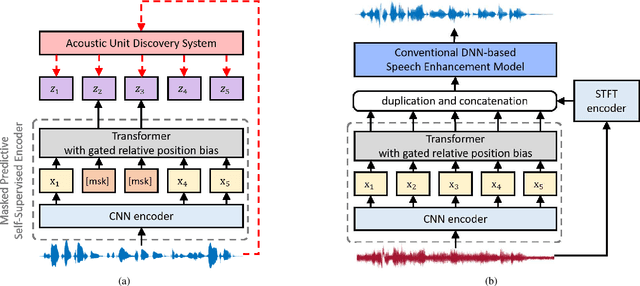
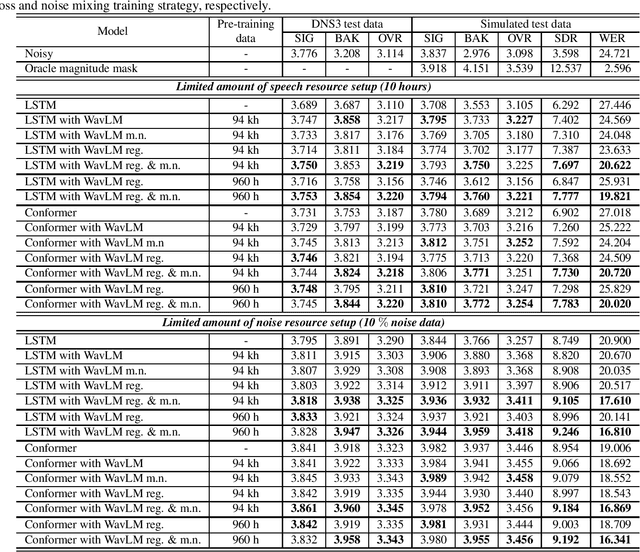

There is a surge in interest in self-supervised learning approaches for end-to-end speech encoding in recent years as they have achieved great success. Especially, WavLM showed state-of-the-art performance on various speech processing tasks. To better understand the efficacy of self-supervised learning models for speech enhancement, in this work, we design and conduct a series of experiments with three resource conditions by combining WavLM and two high-quality speech enhancement systems. Also, we propose a regression-based WavLM training objective and a noise-mixing data configuration to further boost the downstream enhancement performance. The experiments on the DNS challenge dataset and a simulation dataset show that the WavLM benefits the speech enhancement task in terms of both speech quality and speech recognition accuracy, especially for low fine-tuning resources. For the high fine-tuning resource condition, only the word error rate is substantially improved.